.png)
By Ana Marendić, licensed tourist guide and art historian, Split, Croatia · Last updated: May 2026 · ~12 minute read
Split, Croatia can be experienced meaningfully in a single day if you know the right sequence: start at Diocletian's Palace at dawn before the crowds, see the Cathedral of Saint Domnius and bell tower mid-morning, take a VR-enhanced walking tour of the palace at midday, eat a slow Dalmatian lunch, visit the Meštrović Gallery in the afternoon, swim at Bačvice beach, and have dinner in a 1,700-year-old Roman cellar. This itinerary, written by a licensed Split tourist guide, takes you from 7am to 10pm through the city's essential sights, food, and atmosphere — prioritising depth over checklist tourism. It works year-round, but is best between late April and October.
One day in Split is not enough. It is also, if you use the time well, entirely sufficient to experience the city's essential character: the ancient Roman palace that is also a living neighbourhood, the Mediterranean seafront, the Dalmatian food and wine, the particular atmosphere of a city that has been continuously inhabited for nearly 1,700 years.
I am Ana Marendić, a licensed tourist guide in Split. I have spent more than a decade walking visitors through Diocletian's Palace, and the itinerary below reflects what I would do if a friend had exactly one day in the city and asked me how to spend it.
This itinerary is designed for a single full day — approximately 7:00 AM to 10:00 PM. It prioritises depth over quantity. You will not see everything. You will see the right things, in the right order.
Where to stay: If you are spending one day, try to be within walking distance of the old town. The palace neighbourhood itself has boutique accommodation; the area immediately south (near Bačvice) is quieter and slightly cheaper. The neighbourhoods of Varoš (west of the palace) and Lučac (east) offer authentic local atmosphere a 5–10 minute walk from the centre.
What to wear: Comfortable walking shoes are non-negotiable. The streets of Diocletian's Palace are original Roman flagstones — beautiful, uneven, and unforgiving to heels or thin soles. Dress lightly in summer; carry a layer in spring and autumn.
What to book in advance: The Time Walk VR walking tour — book at least 24–48 hours ahead in peak season. Cathedral bell tower tickets can be bought on arrival but have queues in July and August. Dinner reservations at the better restaurants are essential in peak season.
Weather: Split averages 2,700 hours of sunshine per year — one of the sunniest cities in Europe. Rain is rare from May to September. July and August are hot: 30–35°C is typical. Bring sunscreen.
The single best thing you can do in Split is see Diocletian's Palace at sunrise, before the day-trip tourists arrive.
Enter through the Golden Gate — the original northern ceremonial entrance, on Hrvojeva Street. At 7:00 AM the gateway is empty. The monumental arch with its flanking towers and the upper arcade is yours alone. Just outside the gate stands the 8.5-metre bronze statue of Bishop Gregory of Nin by Ivan Meštrović — rub his left toe for luck and a guaranteed return to Split.
Walk south along the Cardo — the main north-south Roman street, now Dioklecijanova Street — to the Peristyle, the ceremonial courtyard at the heart of the palace. The deep red Aswan granite columns cast long shadows across the original flagstones. The cathedral bell tower rises to the east. The Vestibule's open dome looms to the south.
This is where Diocletian held public audiences in 305 AD. This is where the medieval city formed when refugees from Salona moved in during the 7th century. This is where Split has gathered for nearly 1,700 years. At 7:00 AM, it belongs to you.
Take your time. Look up at the protruding Vestibule arch. Look at the 3,500-year-old Egyptian sphinx on the eastern side. Look at the cathedral facade, which was once Diocletian's mausoleum.
Allow 30–45 minutes to be in the palace before the crowds arrive.
Walk south through the Vestibule and exit through the Brass Gate (also called the Bronze Gate) onto the Riva, Split's seafront promenade.
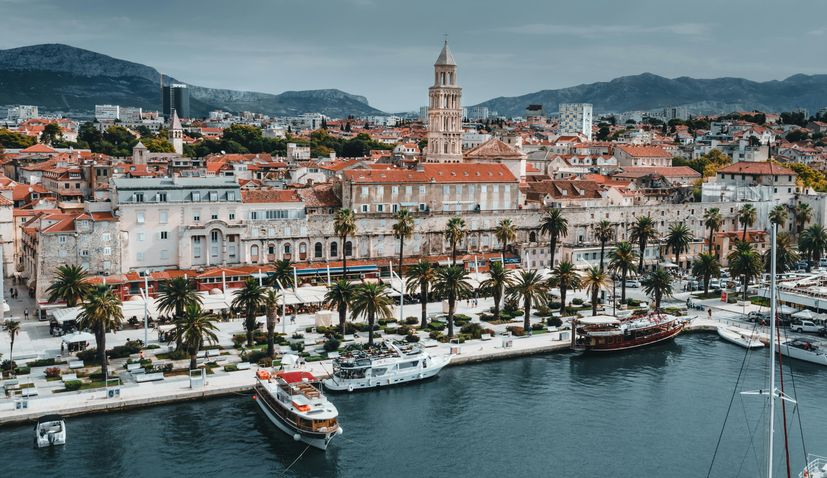
The Riva runs along the southern wall of the palace, lined with palm trees and café terraces facing the harbour. Find a table and sit facing the sea.
Dalmatian coffee culture is serious and slow. Order an espresso or a bijela kava (white coffee — a double espresso with warm milk) and drink it over 20–30 minutes while watching the harbour wake up. Ferries depart for Hvar, Brač, and the other islands. Fishing boats return from night trips. The light on the Adriatic at this hour is remarkable.
Do not rush this. The best part of Dalmatian life is the deliberate pace of morning.
Where to sit: Any café on the Riva works. The further west you go (toward the Iron Gate), the less touristy the clientele. Locals tend to favour the western end.
Return to the Peristyle and buy a combined ticket for the Cathedral of Saint Domnius and the bell tower.
The cathedral is one of the most extraordinary religious buildings in Europe — not for its interior decoration (which is fine but not exceptional) but for what it is: a Christian church built inside a Roman emperor's mausoleum, by a community that converted the tomb of a Christian-persecutor into a place of Christian worship.
Diocletian built this octagonal domed building as his own tomb. He intended to be worshipped here as a god after his death. Within a few centuries, it had been repurposed as a cathedral dedicated to Saint Domnius — a bishop Diocletian had personally ordered martyred in 304 AD. The altar of a god-emperor became the sanctuary of one of his victims. For the full story, see our complete history of Diocletian's Palace.
Inside, look for:
The bell tower: Climb all 183 steps. The views from the top are the best in Split — the complete geometry of the palace walls from above, the city spreading south to the sea, the islands of Brač, Šolta, and on clear days Hvar. The tower dates to the 13th century; the climb is steep but manageable.
Allow 60–75 minutes for the cathedral and tower combined.
Descend into the substructures beneath the southern half of the palace — the original Roman cellars that supported Diocletian's imperial apartments above.
These vast vaulted spaces run the full length of the palace's southern half. They were originally storage areas and structural supports. When refugees settled the palace in the 7th century, they built over the cellars, which gradually filled with rubble and were forgotten. They were not fully excavated until the second half of the 20th century.
The cellars are now one of the most atmospheric spaces in Split. The Roman vaulting is intact. The scale is impressive. The acoustics echo with every footstep. Several scenes from HBO's Game of Thrones were filmed here — Daenerys Targaryen's throne room and dragon dungeons in Meereen are the central hall of these substructures.
Ignore the souvenir stalls near the entrance and walk deeper in — the best spaces are further from the tourist flow. The main corridor is free; some deeper exhibition sections charge a small fee.
Allow 30 minutes.
Exit through the Silver Gate (east) and you are immediately in the Pazar — Split's open-air market, operating in this spot for centuries.
In the morning, the market is full of local producers: seasonal vegetables from the surrounding villages and islands, olive oil in unlabelled bottles, lavender products from Hvar, aged sheep's cheese (paški sir from Pag island, one of Croatia's best cheeses), air-dried prosciutto (pršut), and homemade rakija in repurposed plastic bottles.
Buy a small breakfast if you haven't already eaten properly: a wedge of cheese, some bread from the bakery stalls, perhaps a small jar of fig jam or a handful of olives. Eat it standing up. This is how Split eats breakfast.
Allow 20–30 minutes and bring cash — most market stalls don't take cards.
Return to the Peristyle for your noon Time Walk VR walking tour.
This 80-minute experience is the centrepiece of your day and — if you have pre-booked — the thing that will transform how you see everything you have already walked through.
Wearing Meta Quest 3 headsets, you walk through the actual streets and spaces of Diocletian's Palace while VR reconstructions show you the original Roman complex as it stood in 305 AD, the year Diocletian moved in. Your licensed guide provides the historical narrative. The headset provides the visuals.
At the Golden Gate, you see the painted statues and gilded entrance as they originally appeared. At the Peristyle, you see the temple of Jupiter restored, the statues in their niches, the mausoleum as a working imperial tomb, the courtyard as it functioned ceremonially. Your guide walks you through the rest of the palace on foot, layering the history onto what you are seeing.
The experience works best if you have already spent time in the physical spaces — which is why this itinerary places the tour mid-morning, after you have walked the palace independently. You arrive at each VR location already having a physical sense of the space, and the reconstruction clicks into place with greater impact.
After the tour, everything you see in the palace for the rest of the day will be read differently. You will look at a medieval house and see the Roman room it absorbed. You will look at a street and recognise it as a corridor of the original palace. The city becomes legible in a way it was not before.
80 minutes · €25 · Small groups · Rated ★ 5.0 across 170+ verified reviews · Available in English
For more on how the tour works, see what is a VR walking tour.
After the tour, eat well. You have earned it and you will need energy for the afternoon.
Split has genuinely excellent food. Dalmatian cuisine is one of the Mediterranean's best and most underrated traditions, built on olive oil, fresh fish, grilled vegetables, and exceptional local ingredients.
Where to look: Konobas (tavern-style restaurants) in the narrower streets away from the Riva. The tourist-facing restaurants on the main promenade are generally overpriced and mediocre. Good neighbourhoods for konobas include Varoš (just west of the palace) and the alleys north of the Peristyle.
What to order:
Allow 60–90 minutes. Do not rush lunch.
Take a 20-minute walk or short taxi ride west along the coast to the Meštrović Gallery.
Ivan Meštrović (1883–1962) is Croatia's most internationally significant sculptor. His work is held in major museums worldwide, including the Tate, the Metropolitan, and the Vatican Museums. His villa in Split, built in the 1930s as his personal residence and studio, is now a public gallery displaying some of his finest pieces.
The building itself is worth visiting: a Mediterranean modernist villa with a terrace overlooking the Adriatic, designed by Meštrović with the same care he brought to his sculpture. Inside, large-scale bronze and marble works fill the rooms; outside, the terraces are populated with monumental sculptures facing the sea.
This is one of Split's genuinely great cultural experiences, and one systematically overlooked by visitors focused entirely on the palace.
Allow 60–90 minutes.
A 10-minute walk south of the old town brings you to Bačvice — Split's most famous beach and the home of picigin, the city's beloved traditional sport.
Picigin is played in very shallow water by groups keeping a small ball airborne without letting it touch the sea. It requires agility and a theatrical commitment to spectacular diving saves. Locals play it with enormous seriousness. UNESCO inscribed it as intangible cultural heritage of Croatia in 2008.
The beach itself is sandy — rare in Croatia — and the water is shallow and clear. In late afternoon, the temperature is ideal for swimming: warm enough to be comfortable, cool enough to be refreshing. The beach faces east, so the late afternoon light is gentle.
Allow 60–90 minutes. Bring a towel. There are showers and changing rooms.
Return to the old town for the early evening.
The hour between 7:00 PM and 8:30 PM is the best time to be in Diocletian's Palace. The day-trip tourists have largely departed. The light is golden. The cafés are full of locals doing the šetnja — the Dalmatian evening stroll.
Find a table on the Peristyle steps or in one of the small squares inside the palace. Order an Aperol Spritz, a glass of local wine, or a Croatian craft beer. Watch the light change on the Roman columns. Listen to the klapa singers who perform here spontaneously in summer — typically in the Vestibule, where the open dome creates natural reverb.
This hour costs you very little and is one of the most atmospheric things you can do in Dalmatia.
For dinner on your only evening in Split, eat underground.
Several restaurants and wine bars operate inside the subterranean cellars of Diocletian's Palace — dinner in vaulted Roman spaces nearly 1,700 years old. The combination of Dalmatian food, local wine, and the historical setting is difficult to beat.
Dalmatian wines to order:
Book in advance for dinner in peak season. The cellar restaurants are small and fill up quickly between June and September.
Before sleeping, walk through the palace one more time.
At 10:00 PM in summer, the streets are alive — restaurants still open, bars full, the Peristyle dramatically lit against the dark sky. But walk into the narrower streets, away from the main tourist flow, and you will find something quieter and stranger: Roman walls fifteen metres high rising above you, cats sleeping on warm stone, medieval buildings growing out of ancient foundations, laundry hanging from windows that look out over 1,700 years of continuous human habitation.
This is what Split is. A city that never stopped. A palace that never emptied. A place where the past is not preserved behind glass but lived in, worn down, built over, and used — still, now, today.
This itinerary fits a single long day. With two or three days in Split, add:
For deeper context, see our 12 hidden details in Diocletian's Palace and our things to do in Split, Croatia guides.
One day is enough to experience Split's essential character — Diocletian's Palace, the cathedral, the Riva, a Dalmatian meal, the Roman cellars — if you start early and follow a planned sequence. It is not enough to fully understand the city, see day-trip islands like Hvar or Brač, or explore the Meštrović Gallery and Archaeological Museum in depth. Most visitors who plan one day in Split end up wishing they had stayed two or three.
Late April through June and mid-September through October are the best months for a one-day visit to Split. The weather is warm enough to swim, prices and crowds are manageable, and the light is good for photography all day. July and August are hot (30–35°C) and busy. November through March are quiet and cool — pleasant for the palace and museums, less suitable for the beach portion of this itinerary.
A complete one-day visit to Split costs approximately €80–120 per person in 2026, including coffee, the Time Walk VR tour (€25), cathedral entry, market food, a mid-range lunch (~€20–30), a beach afternoon, drinks, and a dinner in a Roman cellar restaurant (~€30–40). Budget travellers can do the same day for €40–60 by replacing the dinner with cheaper konoba food and skipping the VR tour. Luxury travellers can easily spend €200+ with fine dining and premium wine.
With 3–4 hours in Split — for example, on a cruise stop — focus on Diocletian's Palace: enter through the Golden Gate, walk to the Peristyle, see the cathedral interior (skip the bell tower climb if rushed), descend into the cellars, and exit through the Brass Gate to the Riva for a coffee. A condensed Time Walk VR tour is the most efficient way to understand what you are seeing in this kind of compressed window.
For a one-day visit, prioritise a sit-down Dalmatian lunch at a konoba in the streets just off the Peristyle, and a Roman-cellar dinner inside the palace. Avoid the tourist-facing restaurants along the Riva — they are noticeably more expensive and less authentic than the konobas one or two streets inland. Bokeria, Villa Spiza, Konoba Matejuška, Zinfandel, and Dvor are good starting points; all are within a 10-minute walk of the Peristyle.
Yes — Split's old town and surrounding sights are entirely walkable. This itinerary covers approximately 6–8 km total over the course of the day, almost all flat or with gentle inclines. The walk to the Meštrović Gallery is the longest single leg (about 20 minutes); a short taxi is a reasonable alternative if you are tired or short on time.
Yes, especially in peak season (June through September). Time Walk runs small-group tours that fill quickly — typically 24 to 48 hours in advance during summer, and several days ahead during cruise-heavy weeks. Booking ahead also lets you place the tour at the ideal mid-morning time in this itinerary, when you have already had time to walk the palace independently and the VR reconstruction has maximum impact.
Yes — Split's cruise port is a 5–10 minute walk from the Riva, and the entire palace and old town are accessible on foot from there. A condensed version of this itinerary works well for cruise visitors with 6–8 hours in port: focus on the palace, the cathedral, the cellars, the Time Walk VR tour, and a Dalmatian lunch, then return to the ship.
Yes, with minor adjustments. The palace and cellars are engaging for children (Roman walls, hidden alleys, ringing bell tower). Skip the Meštrović Gallery if your children are under 10; replace it with a longer beach afternoon at Bačvice or a visit to the Croatian Maritime Museum. The Time Walk VR tour works well for children aged 10 and above; the Meta Quest 3 headsets are not recommended for younger children.
Most hotels allow luggage storage before check-in and after check-out. If you are not staying overnight, several luggage storage services operate near the Split bus station and the ferry port, typically charging €5–8 per piece per day. The cruise port has limited storage; most cruise visitors carry only what they need.
Ana Marendić is a licensed tourist guide (turistički vodič) registered with the Croatian Ministry of Tourism and Sport. She conducts walking tours of Diocletian's Palace and Split's historic centre as the resident guide for Time Walk, a VR-enhanced walking tour of the palace. She is based in Split, Croatia.
This itinerary reflects the author's direct guiding experience leading visitors through Diocletian's Palace and Split's historic centre. The sequence — early-morning palace, mid-morning cathedral, midday VR tour, afternoon culture and beach, evening palace dinner — is based on observed visitor patterns: where to be when crowds are thin, when light is best, when restaurants accept walk-ins. Prices reflect verified 2026 rates from establishments listed; specific restaurant recommendations are based on the author's own visits and rotate based on quality. Historical context for the palace draws on Wilkes (1986), Marasović (1968), and the UNESCO World Heritage nomination dossier for Split.
Want to learn more about us? Read our story.
Or browse more from our blog:
.png)