.png)
By Ana Marendić, licensed tourist guide and art historian, Split, Croatia · Last updated: May 2026 · ~12 minute read
Split and Dubrovnik are the two most-visited cities on Croatia's Dalmatian coast. Split is the more affordable, authentic, and historically deeper choice; Dubrovnik is the more visually spectacular, expensive, and tourist-saturated choice. Split's old town is a 1,700-year-old Roman imperial palace still inhabited by 3,000 residents, with significantly lower prices, the best island ferry connections on the Adriatic, and a working-city atmosphere. Dubrovnik's old town is an intact 13th-century walled medieval city famous as Game of Thrones' King's Landing, with extraordinary visual impact, premium restaurants, and prices comparable to Paris or Rome. This guide, written by a licensed Croatian tourist guide, compares the two cities across history, atmosphere, cost, food, island access, and visitor experience — and explains which city suits which traveller.
Go to Split if you want a real city with 1,700 years of living history, lower prices, the best access to the Croatian islands, and an atmosphere that hasn't been entirely consumed by tourism.
Go to Dubrovnik if you want the most visually dramatic walled city in the Mediterranean, world-class restaurants, and you don't mind crowds and premium prices.
Go to both if you have at least 7–10 days in Croatia. They are 4 hours apart by bus along the coast, and they offer fundamentally different experiences. Most serious Croatia trips include both.
Both cities are on the Dalmatian coast. Both are UNESCO World Heritage Sites. Both have extraordinary old towns built from white limestone, facing the Adriatic, packed with history. From a distance, the comparison sounds even.
It is not. Split and Dubrovnik are fundamentally different places — different in atmosphere, different in what they offer, different in who they suit. Choosing between them, or deciding how to split your time, is the single most common decision international visitors to Croatia face.
I am Ana Marendić, a licensed tourist guide in Split. I have lived in Split for over a decade and worked across both cities. Below is an honest comparison — no tourism-board spin, no false equivalence. Where one city is genuinely better, I say so.
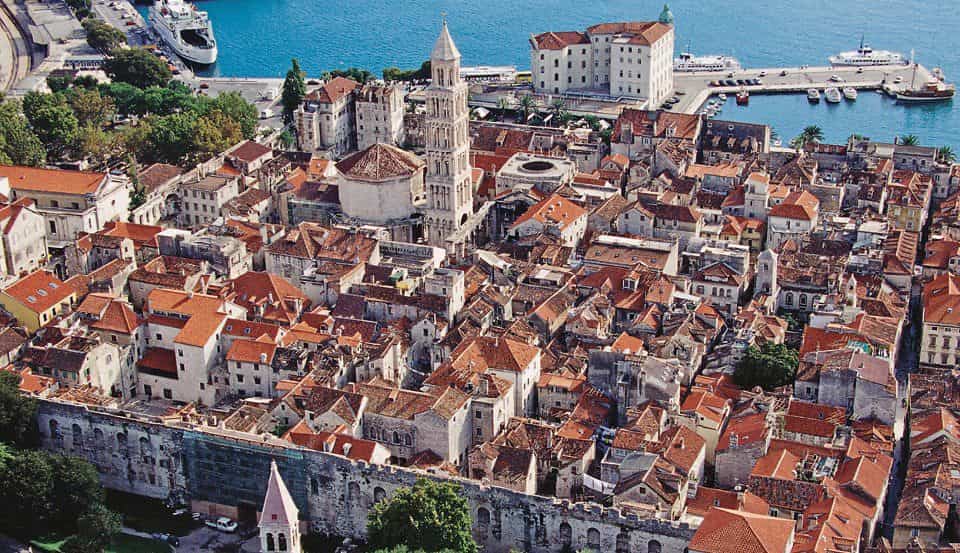
Split's history is longer and stranger than Dubrovnik's. The city exists because a Roman emperor built his retirement palace here in 305 AD. When the regional capital of Salona was destroyed by Avar and Slavic invasions in the early 7th century, the surviving population moved into the abandoned imperial palace and never left.
The result is unique in the world: a Roman imperial complex that became a medieval city that became a modern city, all layered on top of each other and all still in use. The walls of Diocletian's Palace are the walls of apartment buildings. The emperor's mausoleum is the cathedral. The Roman cellars are wine bars. The original Roman streets are the streets people walk to work on every morning.
There is no other city on earth with 1,700 years of unbroken habitation inside an imperial Roman building. For a complete account, read our complete guide to the history of Diocletian's Palace and our guide to Emperor Diocletian himself.
Depth of history: Extraordinary. 1,700 years of continuous habitation in one Roman building.
Dubrovnik's history is shorter but politically remarkable. Founded in the 7th century, it developed into the Republic of Ragusa — an independent city-state that survived for over 450 years (1358–1808) through a combination of diplomatic skill, strategic neutrality, and considerable wealth from maritime trade between East and West.
The Republic of Ragusa was, for its time, unusually progressive. It abolished the slave trade in 1416, maintained a sophisticated welfare system, established quarantine procedures during the plague (the word quarantine itself comes from the Italian quaranta giorni — 40 days), and produced a remarkable literary and artistic culture. The old town you see today — the walls, the Rector's Palace, the Franciscan monastery — mostly dates from the 14th to 17th centuries, rebuilt after the catastrophic earthquake of 1667.
Depth of history: Significant, particularly for medieval maritime and political history. Less ancient than Split, but more politically fascinating.
Verdict: Split wins on historical depth and architectural uniqueness. There is nothing else like Diocletian's Palace anywhere in the world. Dubrovnik's history is impressive but more typical of Mediterranean walled cities.
Split is a real city. Around 160,000 people live here. The old town — Diocletian's Palace — contains approximately 3,000 residents going about their normal lives: doing laundry on Roman walls, walking dogs through imperial gates, arguing outside cafés in the Peristyle, buying groceries at the Pazar market just outside the Silver Gate every morning.
Tourism is significant but hasn't consumed the city. There are residential neighbourhoods, schools, supermarkets, an obsessive football culture (Hajduk Split is one of Croatia's most fanatical fan communities), and a local life that exists independently of visitors. In the evenings, the people on the Peristyle are a genuine mix of locals, tourists, klapa singers, and groups of teenagers hanging out.
The atmosphere is Mediterranean in the best sense: unhurried, sociable, warm. Split is a city you can actually live in for a few days rather than just pass through.
Dubrovnik is one of the most beautiful cities in Europe. It is also, in peak season, one of the most crowded. The old town's resident population has fallen below 1,500 — down from about 6,000 in 1991 — as locals have been progressively displaced by tourist-oriented accommodation, holiday rentals, and rising costs.
In July and August, the old town receives thousands of cruise passengers per day on top of its hotel guests. The Stradun — the main street — can feel more like a moving queue than a promenade. The city has actively worked to manage this (cruise ship limits introduced in 2019, visitor caps at the main gates, ongoing efforts to retain residents), but the fundamental pressure of a tiny, extraordinarily beautiful space attracting enormous visitor numbers remains.
In May, late September, October, or November, Dubrovnik is genuinely magical. In August, it tests your patience.
Verdict: Split has a more authentic, liveable atmosphere year-round. Dubrovnik is more spectacular but more crowded — and the gap widens dramatically in peak season.
Split is beautiful in a layered, complex way — the beauty of things that have been built, rebuilt, and built over for seventeen centuries. The Peristyle at sunrise. The Riva in evening light. The view from the cathedral bell tower across terracotta rooftops to the Adriatic. The night-time Vestibule with klapa singers. The 3,500-year-old Egyptian sphinx sitting beside a medieval bell tower. These are genuinely memorable images.
But Split's greatest visual experience requires a layer the eye alone can't provide: seeing the palace as it originally appeared. The Time Walk VR walking tour uses Meta Quest 3 headsets to reconstruct the original Roman palace at two key locations — the Golden Gate and the Peristyle — showing you the throne room as a working throne room, the temples intact, the mausoleum as a tomb, the Peristyle as Diocletian saw it in 305 AD. It is an 80-minute experience that transforms how you read the rest of the city. For more on how this works, see what is a VR walking tour.
Dubrovnik's visual impact is immediate and overwhelming. The old town walls — up to 25 metres high, stretching 1,940 metres around the entire city — are one of the most dramatic architectural achievements in Europe. Walking the walls (a 2km circuit with constant views of the terracotta rooftops and the Adriatic) is one of Croatia's essential experiences.
The Stradun is a perfectly preserved medieval street of remarkable visual coherence — buildings on either side were largely rebuilt to the same design after the 1667 earthquake, creating an unusual architectural homogeneity. At night, when the day-trippers have left and the polished limestone pavement reflects the lantern light, it is one of the most beautiful streets in the world.
Verdict: Dubrovnik wins on immediate visual drama. Split's visual rewards are deeper but require more engagement to access.
This comparison isn't close. Split is significantly more affordable than Dubrovnik across every category.
The combination of limited accommodation supply, premium international demand, and a wealthy visitor base has pushed Dubrovnik prices to levels comparable with Paris, Rome, or Amsterdam. Split prices are closer to Lisbon or Athens.
For a detailed breakdown of how to experience Split affordably, see our Split in one day itinerary.
Verdict: Split wins decisively on value. For the same budget, you experience significantly more in Split — better accommodation, better restaurants, more activities, more comfort.
Split's food scene is improving rapidly but still operates at lower price points than Dubrovnik. The best restaurants — places like Bokeria, Konoba Matejuška, Villa Spiza, Zinfandel, Dvor — offer modern Dalmatian cuisine using fresh Adriatic seafood, local lamb from the islands, Brač cheese, and Pelješac wines, typically at €40–60 per person for a full dinner with wine.
The morning Pazar market just outside the Silver Gate is one of the best food markets in the Adriatic — fish, produce, cheese, olive oil, dried meats, all from the surrounding islands and hinterland.
Dubrovnik has Croatia's most concentrated cluster of high-end restaurants. Restaurant 360°, Above 5 Rooftop, Pantarul, Nautika, Kopun — these are the kind of restaurants that draw international food critics. Several have Michelin recognition. Expect €80–150 per person at the top end.
For more casual dining, Dubrovnik's konobas serve the same Dalmatian classics as Split's but at noticeably higher prices.
Verdict: Dubrovnik wins on the very top end of fine dining. Split wins on value, casual dining, and authentic local food markets.
Split is the central hub of Dalmatian island ferry connections. From Split's ferry port you can reach:
The frequency and variety make Split the best base for island-hopping in Croatia. Many visitors use Split as a base and day-trip to a different island each day.
For a fuller overview, see our things to do in Split guide.
Dubrovnik has ferry connections to the Elaphiti Islands (Lopud, Šipan, Koločep) and to Korčula and Hvar, but with fewer options and lower frequency than Split. The Elaphiti Islands are beautiful but small and lightly inhabited — pleasant for a day trip, less suited for a multi-day island-hopping itinerary.
Verdict: Split wins significantly. For visitors prioritising the Croatian islands, Split is the unambiguous base.
Want to understand Split properly — not just see it? Time Walk is a licensed VR-enhanced walking tour of Diocletian's Palace, led by an accredited Split historian. At two locations — the Golden Gate and the Peristyle — guests put on Meta Quest 3 headsets and see the palace reconstructed exactly as it stood in 305 AD, the year Diocletian moved in.€25 · 80 minutes · Small groups · Rated ★ 5.0 across 170+ verified reviews→ Book your tour
Verdict: Split offers significantly more variety in day-trip distance — historical sites, national parks, islands, and other UNESCO towns within 90 minutes. Dubrovnik's day trips are more concentrated on the surrounding area and international border crossings.
Yes, and for most visitors with seven or more days in Croatia, it's worth it. Split and Dubrovnik offer genuinely different experiences. Doing only one leaves a gap in your understanding of the region.
For Game of Thrones fans wanting to visit every filming location in Croatia, see our complete guide to Game of Thrones filming locations in Croatia.
Dubrovnik is one of Europe's great visual spectacles. Split is one of Europe's great historical cities. They're not really in competition with each other — they offer different kinds of experience.
But if you're asking which one to prioritise, and you care about historical depth, authenticity, value, and having room to breathe: Split.
And if you want to understand Split properly — to see Diocletian's Palace as it actually was, not just as the beautiful ruin it appears to be — book the Time Walk VR walking tour. It is the experience that makes everything else in the city click into place.
80 minutes · €25 · Small groups · Rated ★ 5.0 across 170+ verified reviews · Available in English
For most first-time visitors, Split is the better choice — it offers more variety, lower prices, better island access, and a more authentic experience of Croatian daily life. Dubrovnik is visually iconic and a logical second stop, but Split is the more rewarding base for understanding the country. Travellers with very short trips (2–3 days only) and an image-focused itinerary often prefer Dubrovnik for its single overwhelming visual impact.
Yes, significantly. Split is approximately 30–50% cheaper than Dubrovnik across accommodation, restaurants, drinks, and most activities. A mid-range dinner for two with wine costs €50–80 in Split versus €100–150 in Dubrovnik. Hotels near the old town run €80–150 per night in Split versus €250–400+ in Dubrovnik in peak season. Croatia's two most visited cities now have noticeably different price tiers.
Plan for 3 days in Split and 2 days in Dubrovnik as a minimum. Split rewards more time because there is more to do — the palace itself, island day trips, Klis Fortress, Salona, Trogir, Šibenik all within easy reach. Dubrovnik is geographically smaller and its main sights (city walls, old town, Lokrum, Trsteno) can be comfortably covered in 2 full days.
Dubrovnik is the more conventional romantic destination — better fine-dining, more dramatic views, an iconic walled-city atmosphere — but it is also more crowded and significantly more expensive. Split offers a more relaxed kind of romance: long dinners at small konobas, sunset walks on the Riva, easy ferry trips to nearby islands. Couples with bigger budgets and a focus on special occasions often prefer Dubrovnik. Couples wanting a more lived-in, less performative experience prefer Split.
Split. The city is larger and more spread out, with more space for children to move around, lower prices, and a more relaxed pace. Diocletian's Palace is a working city centre that children find genuinely engaging — Roman cellars, hidden alleyways, the cathedral bell tower to climb. Dubrovnik's old town is smaller, more crowded, and the steep stairways and stone steps can be tiring for younger children.
Both, depending on which storyline you care about. Dubrovnik was used as King's Landing throughout the series — the most-used Croatian filming location. Split and its surroundings were Meereen across Seasons 4–6, including Daenerys's throne room (the palace cellars), the Sons of the Harpy ambush (the Vestibule), and Meereen's exterior (Klis Fortress). Hardcore fans visit both. See our complete guide to Game of Thrones in Croatia.
Yes. The two cities are 4–5 hours apart by direct bus along the coast, 5 hours by summer ferry, or 45 minutes by domestic flight. Most visitors with 7+ days in Croatia combine both, typically 3 days in Split and 2–3 days in Dubrovnik. Split → Dubrovnik is the more common direction (north-to-south), often with an overnight stop in Mljet or Korčula in between.
Both cities have city beaches, but for serious beach time you go to the islands. Split's nearest beach is Bačvice (5-minute walk from the old town, sandy, family-oriented) and Kašjuni (15 minutes, larger, more atmospheric). Dubrovnik's nearest beach is Banje (5-minute walk, gravel, dramatic views of the walls). For Croatia's best beaches — Zlatni Rat on Brač, the Pakleni Islands near Hvar, Stiniva on Vis — Split's ferry network is the necessary base.
In shoulder season (May–June, September–October), yes — Dubrovnik is one of Europe's most beautiful cities. In peak season (July–August), the experience is significantly compromised by crowds and inflated prices. If your only option is peak season, consider visiting Dubrovnik as a day trip from Split or Mljet rather than a multi-night base.
Most cruises stop at Dubrovnik because it's geographically closer to other major Mediterranean cruise ports. Cruise visitors typically have 4–8 hours in port, which is enough to see Dubrovnik's old town and walk the walls. Split is reachable by cruise but receives far fewer cruise calls — meaning that, paradoxically, if you arrive in Split by cruise, you'll often have the city more to yourself than Dubrovnik's cruise visitors do.
Ana Marendić is a licensed tourist guide (turistički vodič) registered with the Croatian Ministry of Tourism and Sport. She conducts walking tours of Diocletian's Palace and Split's historic centre as the resident guide for Time Walk, a VR-enhanced walking tour of the palace. She has worked across both Split and Dubrovnik and is based in Split, Croatia.
This comparison draws on the author's direct guiding experience in both Split and Dubrovnik, cross-referenced with current visitor statistics from the Croatian Bureau of Statistics and the Croatian Ministry of Tourism. Price ranges reflect 2025–2026 published rates across mid-range establishments in both cities. Historical context is supplemented by the UNESCO World Heritage nomination dossiers for Split (1979) and Dubrovnik (1979), and standard reference works including Wilkes (1986) on Diocletian's Palace and Harris (2003) on the Republic of Ragusa. Where claims involve subjective judgement — "better atmosphere," "more authentic," "more spectacular" — the article makes the basis for the judgement explicit so readers can disagree if their priorities differ.
Want to learn more about us? Read our story.
Or browse more from our blog:
.png)