.png)
By Ana Marendić, licensed tourist guide and art historian, Split, Croatia · Last updated: September 2026 · ~20 minute read
He was born poor in a Dalmatian backwater. He rose through the Roman military during the worst political crisis in the empire's history. He survived a period when emperors died on average every two years. He restructured Rome itself — reinventing how the empire was governed for the next two centuries. He persecuted Christians on a scale Rome had never seen before. He built the largest baths the city of Rome ever saw. And then, when no Roman emperor had ever done so before him, he voluntarily walked away from power, retired to a palace he had built on the Adriatic coast, and reportedly spent his remaining years growing cabbages.
This is the story of Diocletian — one of the most consequential, contradictory, and personally fascinating figures in Roman history. The man who built the structure that became modern Split.
Diocletian was born around 244 AD in or near Salona, the Roman provincial capital of Dalmatia. Salona stood a few kilometres inland from the site where, sixty years later, he would build his retirement palace. The ruins of Salona are still visible today, near the modern town of Solin.
His origins were modest. Ancient sources describe his father as either a scribe (a clerk or copyist) or a freed slave who had worked for a Roman senator named Anullinus. Either way, the boy who would become emperor was not born into wealth, power, or imperial blood. In the rigid hierarchies of Roman society, his rise is one of the most dramatic in the empire's 1,200-year history.
His birth name was probably Diocles — a Greek-derived name common in the Balkan provinces. He took the Latin name Diocletianus only after his elevation to emperor, in keeping with the Roman tradition that emperors adopted more dignified, classical names on taking the throne.
There is almost nothing reliable in the historical record about his childhood. Like many Roman provincials of his era, he likely joined the army as a young man. The Roman military was the great social leveller of the empire — a place where talent, brutality, and luck could lift a man from the provinces to the centre of power.
By the early 270s AD, Diocletian was serving as an officer. He fought under Emperor Aurelian, one of the so-called "soldier emperors" who briefly stabilised the empire before being assassinated in 275 AD. By 282 AD, Diocletian had risen to the rank of commander of the imperial bodyguard (protectores domestici) under Emperor Numerian.
To understand Diocletian's career, you have to understand the world he stepped into.
The Roman Empire in the 3rd century AD was in a state of near-permanent crisis. Historians call this period the Crisis of the Third Century (235–284 AD). In those fifty years, the empire was ruled by more than fifty claimants to the throne, most of whom died violently. The average reign was approximately two years.
The crisis had multiple causes: invasions by Germanic and Persian forces, plague (including the Plague of Cyprian which killed millions), hyperinflation, the collapse of trade networks, separatist breakaway states in Gaul and the East, and a Roman political culture that had become incapable of orderly succession. Emperors were proclaimed by the military, ruled briefly, and were typically killed by their own troops or by rival claimants.
Diocletian came of age in this chaos. He survived it.
In November 284 AD, Diocletian became emperor through one of the most dramatic accessions in Roman history.
Emperor Numerian died in suspicious circumstances during a campaign against the Persians. According to ancient sources, his body was discovered in his sealed travel litter, decomposing — having apparently been dead for some days while his praetorian prefect Aper concealed the death and continued to give orders in his name.
The army assembled in council at Nicomedia. Diocletian, then aged about forty, stood before the assembled troops, raised his sword, and accused Aper of murder. Before Aper could defend himself, Diocletian personally killed him with the sword, in full view of the army. The troops, witnessing this act, proclaimed Diocletian emperor on the spot.
The killing was almost certainly political theatre. Whether Aper had actually murdered Numerian is unclear; what mattered was that Diocletian eliminated the only living person who could plausibly contradict his version of events.
The following year, Diocletian defeated and killed Carinus — Numerian's brother and rival emperor in the West — at the Battle of the Margus in the Balkans. By the spring of 285 AD, Diocletian was the undisputed emperor of Rome.
He inherited a broken empire.
Diocletian's central insight was that the Roman Empire had become too large, too complex, and too unstable for a single ruler to govern alone. Every previous emperor had tried; every previous emperor had eventually failed.
His solution was unprecedented: split the empire into manageable parts, each with its own emperor.
In 285 AD, he appointed Maximian as co-emperor (Augustus) in the West, while Diocletian himself ruled the East. The two men were notionally equal in rank, though Diocletian was always the senior partner. To bind them together with religious authority, Diocletian took the divine title Iovius — "of Jupiter" — and gave Maximian the title Herculius — "of Hercules." In Roman religious thinking, Diocletian was now the earthly representative of Jupiter, the king of the gods; Maximian was the representative of Hercules, Jupiter's loyal mortal son.
In 293 AD, he expanded the system. Each Augustus appointed a junior emperor (Caesar):
This was the Tetrarchy — the rule of four. The empire was divided into four administrative regions, each with its own court, military, and bureaucracy:
The Caesars were also designated heirs: when an Augustus died or retired, his Caesar would be promoted, and a new Caesar would be appointed beneath him.
It was a radical restructuring of Roman imperial government — and remarkably, it worked. For more than twenty years, the empire enjoyed political stability it had not seen in a century. The Tetrarchy halted the spiral of usurpations and civil wars that had nearly destroyed Rome.
Diocletian inherited an army that had been gutted by fifty years of civil war and could no longer defend its frontiers. He rebuilt it.
He roughly doubled the size of the Roman army — from approximately 300,000 men under Marcus Aurelius to an estimated 500,000–600,000 by the end of his reign, according to the analysis of the contemporary historian Lactantius. This expansion required entirely new recruitment systems, more centralised supply chains, and reformed pay structures.
More importantly, he reorganised the army into two distinct categories:
This split — frontier garrison plus mobile reserve — became the foundation of late Roman military doctrine and survived into the Byzantine period. It is the structure that allowed the Eastern Roman Empire to defend itself for another thousand years after the Western Empire had collapsed.
He also professionalised the praetorian guard, reduced its political role, and increased recruitment from the Balkan provinces — where he himself had come from, and which had a centuries-long tradition of producing tough Roman soldiers.
In 301 AD, Diocletian launched one of the most ambitious economic interventions in ancient history: the Edictum de Pretiis Rerum Venalium — the Edict on Maximum Prices.
After fifty years of currency debasement and runaway inflation, the empire's economy was in crisis. Diocletian's response was sweeping. The edict fixed maximum prices for over 1,200 goods and services — from wheat and wine to silk garments, slaves, and the daily wages of carpenters, scribes, and lawyers. Violators faced the death penalty.
The edict was carved on stone tablets and posted across the empire. Fragments survive today in museums from Greece to Egypt, and these inscriptions remain one of the most important sources for understanding daily economic life in late antiquity.
The policy ultimately failed. Goods disappeared from markets, black markets flourished, and within a few years the edict had been abandoned in practice. But its ambition tells us something important about Diocletian: he was willing to attempt structural reforms that no previous emperor had dared.
Alongside the Tetrarchy, Diocletian reorganised the empire's internal administration on a scale unmatched since Augustus.
He roughly doubled the number of provinces — from approximately 50 to over 100 — making each smaller and easier to govern. He grouped these provinces into twelve larger administrative units called dioceses, each headed by an official called a vicarius reporting to the praetorian prefect. This new layer of administration is the direct ancestor of how the Catholic Church later organised its territorial divisions — the word "diocese" itself comes from Diocletian's system.
He also formally separated civil and military authority within each province. Governors handled administration and justice; separate military commanders (duces) handled defence. This separation made it harder for individual officials to mount usurpations against the throne — directly addressing the structural problem that had produced fifty years of civil war.
The system Diocletian created in the 290s outlived Rome itself. The Byzantine Empire ran on Diocletian's administrative framework for centuries.
Diocletian did not just reform the Roman state — he reinvented what it meant to be a Roman emperor.
For three centuries, Roman emperors had carefully maintained the fiction that they were the "First Citizens" (princeps) of a republic that, in theory, still existed. They wore senatorial togas. They were called by their family names. They allowed others to address them informally. The system, called the Principate, dated to Augustus.
Diocletian ended it.
He took the title Dominus et Deus — Lord and God. He wore a jewelled diadem and gold-threaded silk robes inspired by the Persian court. He required visitors to perform proskynesis — the ritual of kneeling and kissing the hem of the emperor's robe — before approaching him. He removed himself from public view, surrounded by elaborate court ceremony, accessible only through carefully managed audiences.
This new style is called by historians the Dominate — the absolute monarchy that replaced the disguised monarchy of the Principate. Every later Roman and Byzantine emperor inherited this style from Diocletian.
The political logic was straightforward. Forty years of civil war had taught Diocletian that the emperor was vulnerable so long as he was treated as merely a powerful Roman politician. By elevating the emperor to divine, untouchable status, surrounded by ritual that recalled the courts of Persian and Hellenistic god-kings, Diocletian made the office harder to challenge, harder to assassinate, and harder to imagine without.
It worked. The next emperor to be killed by his own troops was murdered three centuries later.
Between 298 and 306 AD, Diocletian built the largest public baths the city of Rome ever saw — and one of the most ambitious construction projects in the history of the ancient world.
The Baths of Diocletian (Thermae Diocletiani) covered approximately 13 hectares (32 acres) — over four times the area of his palace at Split. They could accommodate roughly 3,000 bathers simultaneously. The central frigidarium (cold bath hall) was vaulted by some of the most ambitious concrete construction in Roman history; its dimensions surpassed those of any Roman bath complex before or after.
Ironically, Diocletian himself almost certainly never used them. He spent almost no time in Rome — the city was no longer the empire's administrative centre — and visited only once during his reign, in 303 AD, when the baths were still under construction. The building was completed under his successors and inaugurated in 306 AD, dedicated to him by Maximian.
The Baths survived the fall of Rome. In the 16th century, Pope Pius IV commissioned Michelangelo to convert the central frigidarium into a church — the Basilica of Santa Maria degli Angeli e dei Martiri, which still stands today on Rome's Piazza della Repubblica. Inside it, you can see the original Roman vaulting Diocletian commissioned. The same emperor whose palace forms the historic centre of Split also built one of Rome's most-visited religious sites.
One of Diocletian's most stubborn challenges was a breakaway empire that lasted ten years on the western edge of his domain.
In 286 AD, a Roman naval commander named Carausius — charged with defending the English Channel from Saxon and Frankish pirates — rebelled and declared himself emperor of Britain and northern Gaul. He had control of the Channel fleet, fortified Britain, and minted his own coins bearing his portrait alongside those of Diocletian and Maximian (whom he ironically depicted as brothers, in hopes they might accept him as a junior colleague).
They did not. But for nearly a decade, the Tetrarchs could not dislodge him.
Carausius was finally assassinated in 293 AD by his own treasurer, Allectus, who succeeded him as a usurper emperor of Britain. In 296 AD, Constantius Chlorus — Diocletian's western Caesar — launched a two-pronged invasion of Britain. Allectus was killed in battle; Britain was reconquered. The recovery of Britain is commemorated on a famous gold medallion of Constantius, surviving today in the British Museum, showing him at the head of an army being welcomed back to Londinium by a kneeling personification of the city under the legend REDDITOR LUCIS AETERNAE — "Restorer of the Eternal Light."
The Carausius affair illustrates both the weakness Diocletian inherited (his predecessors had let a Channel commander seize an entire province) and the strength of the Tetrarchy he built (the system eventually reabsorbed Britain without civil war).
For most of his reign, Diocletian did not set foot in Rome. He ruled the empire from Nicomedia, in modern Turkey. He visited Rome only once that we know of — in 303 AD, for the celebrations of his Vicennalia (20-year reign anniversary).
The visit was a major event. Diocletian and Maximian celebrated a joint triumph for their military victories; Diocletian inaugurated his nearly-completed baths; and the Tetrarchs erected a monument in the Roman Forum — the so-called Five-Column Monument — to mark the anniversary. The bases of those columns still survive in Rome; one of them, the Decennalia Base, can be seen today in the Forum and contains some of the best-preserved imperial sculpture of the Tetrarchic period.
Diocletian apparently disliked the visit. According to Lactantius, he was uncomfortable with Rome's republican-era traditions of free speech in popular ceremonies, and left the city before the formal end of his consulship in January 304 AD. He travelled north in heavy weather, fell seriously ill, and nearly died — an illness that may have hastened his decision, eighteen months later, to abdicate.
Diocletian's legacy is permanently complicated by the Great Persecution of Christians, launched in 303 AD.
The persecution unfolded in waves. In February 303 AD, an imperial edict ordered:
A second edict followed, ordering the arrest of Christian clergy. A third offered amnesty to clergy who sacrificed to Roman gods. A fourth — the most severe — extended the requirement to sacrifice to all Christians, on penalty of imprisonment, torture, or execution.
The persecution lasted, in various forms and intensities across different parts of the empire, until 311 AD. It was the most systematic anti-Christian campaign in Roman history.
The historical record on Diocletian's personal role is debated. Some sources suggest his Caesar Galerius was the driving force behind the persecution, with Diocletian initially reluctant. Other accounts hold Diocletian personally responsible. What is clear is that Diocletian was deeply religiously conservative, committed to traditional Roman polytheism, and viewed the spread of Christianity as a threat to the religious unity that he believed underpinned Roman order.
A widely repeated story holds that the immediate trigger was an incident in 302 AD when Christian members of the imperial household made the sign of the cross during a haruspicy ritual (the reading of sacrificial entrails), causing the reading to fail. Whether or not this specific incident occurred, the underlying tension between traditional Roman religion and the rapidly growing Christian community had been building for years.
Diocletian had also persecuted other religious minorities. In 296 or 302 AD — sources differ — he issued an edict against the Manichaeans, an Eastern religious sect of Persian origin, ordering their leaders burned alive and their followers exiled to the mines. The Manichaean persecution prefigured the Christian one and reflects the same impulse: religious uniformity as the foundation of imperial order.
The persecution did not work. Christianity not only survived but emerged stronger. Within a generation, Constantine — the son of Diocletian's western Caesar Constantius Chlorus — would issue the Edict of Milan (313 AD) granting Christians religious freedom, and within Constantine's lifetime Christianity would become favoured by the imperial state.
There is a sharp historical irony here. Diocletian built his retirement palace with an octagonal mausoleum at its heart — intended for his own burial as a deified emperor. Within a few centuries, that mausoleum had been converted into a Christian cathedral dedicated to Saint Domnius, a bishop whom Diocletian had personally martyred in 304 AD as part of the Great Persecution.
The man who tried to destroy Christianity was buried in a building that became one of the world's oldest cathedrals — dedicated to one of his victims.
If you want to walk inside this mausoleum-turned-cathedral and understand what it was, our history of Diocletian's Palace covers the full story of how the building changed function across 1,700 years.
In the late 290s AD, Diocletian began building a palace on the Adriatic coast, near his birthplace at Salona. Construction took approximately ten years. It was completed around 305 AD.
The site was carefully chosen: close to home, defensible (located on a small peninsula), and pleasant — protected from the worst weather by surrounding hills, facing south to the sea.
The palace was not a single building but a fortified complex covering approximately 3 hectares (30,000 square metres). It was designed as both an imperial residence and a military garrison, with high walls (up to 26 metres on the northern side), four gates oriented to the cardinal directions, and an internal layout based on a Roman military camp (castrum).
The southern half of the complex contained Diocletian's private apartments, opening onto a colonnaded gallery overlooking the Adriatic. The northern half contained quarters for soldiers, servants, and administration. Two main streets (the Cardo and Decumanus) crossed at the centre, dividing the complex into four quadrants.
At the heart of the southern half stood the Peristyle — a colonnaded ceremonial courtyard. On its western side was the Temple of Jupiter (later converted into a baptistery). On its eastern side was the octagonal mausoleum intended for Diocletian's burial. Through an archway to the south was the Vestibule — a circular domed anteroom leading into the imperial apartments.
The building stone came mostly from the island of Brač — the same white limestone that would later be used in countless monuments across the Mediterranean and (according to one popular but disputed claim) in the construction of the White House in Washington DC. Granite columns were imported from Egypt. Marble came from Greece.
Diocletian's Palace remains one of the best-preserved Roman imperial residences in the world — partly because, after Diocletian's death, the palace was never abandoned. Refugees from nearby Salona moved inside its walls in the 7th century, and the palace has been continuously inhabited ever since. Today, around 3,000 people live within its walls. For the full story of the building across 1,700 years, see our complete history of Diocletian's Palace.
On 1 May 305 AD, Diocletian did something no Roman emperor had ever done: he resigned.
In a public ceremony at Nicomedia (modern Izmit, Turkey), he removed his imperial purple robe and handed power to his Caesar Galerius. His co-emperor Maximian, who had reluctantly agreed in a parallel agreement at the holy Mount Albano, simultaneously abdicated in Milan in favour of Constantius Chlorus.
Maximian's abdication was forced. He had no wish to retire — by all accounts he loved imperial power — but Diocletian had insisted that the Tetrarchy required both senior emperors to step down together, to ensure orderly succession. The two men had sworn an oath at the Capitoline Temple in Rome during their 303 visit, binding themselves to retire at the same moment. Whether Maximian truly understood, or merely agreed under pressure, has been argued ever since. His subsequent attempts to reclaim power, leading to his suicide in 310 AD, suggest the second.
The Tetrarchy was meant to ensure orderly succession. In theory, the two new Augusti would each appoint a new Caesar, and the system would continue indefinitely. In practice, it collapsed almost immediately into civil war.
Diocletian retired to his completed palace at Split. He was approximately 60 years old.
A famous anecdote — preserved most prominently in the late-4th-century Epitome de Caesaribus, often attributed to Aurelius Victor — captures Diocletian's view of his retirement. When his former colleagues, embroiled in the civil wars that followed his abdication, urged him to return to power, he is reported to have replied:
"Utinam Salonae possetis visere olera nostris manibus instituta, profecto numquam istud temptandum iudicaretis."
"If you could see the vegetables I have planted with my own hands at Salona, you would certainly never judge that to be worth attempting."
The vegetables are commonly translated as "cabbages" — though the Latin word olera simply means "garden vegetables" generally. The image of the retired emperor in a kitchen garden, refusing to trade peace for power, became one of the most enduring anecdotes of ancient history. Whether the words are genuine or invented by later authors, the underlying claim — that Diocletian chose private retirement over a return to power — is well-attested.
He spent his final years in the palace, gardening, receiving occasional visitors, and watching the imperial system he had created fracture from a safe distance.
Ancient sources are unclear on the precise date of Diocletian's death. Most historians place it between 311 and 313 AD. He would have been approximately 66 to 68 years old.
The cause of death is equally uncertain. Some sources suggest natural causes — old age, perhaps stomach illness. Others, including Lactantius, suggest he committed suicide by self-starvation, reportedly in response to the Christian-favouring policies of his successors, the humiliation of Maximian's death, and the destruction of his political legacy.
What is clear is that he died in his palace at Split and was buried in the mausoleum he had built for himself. His tomb was probably destroyed in the 7th century when the building was converted into a Christian cathedral; no certain physical remains of Diocletian survive.
His wife Prisca and daughter Valeria — both reportedly sympathetic to Christianity — were caught up in the political turmoil following Diocletian's abdication. Both were executed around 314–315 AD by Licinius, one of Diocletian's successors. The line of the man who tried to destroy Christianity ended within a decade of his death.
No two late Roman emperors are more entangled than Diocletian and Constantine — and no two are more diametrically opposed.
Diocletian inherited a broken empire and rebuilt it. He believed Rome's salvation lay in restoring traditional religion, dividing imperial power among four rulers, and crushing the rising Christian movement that he saw as a threat to imperial unity.
Constantine — the son of Diocletian's western Caesar Constantius Chlorus — inherited Diocletian's reformed empire and turned it on its head. He reunified imperial power under a single ruler, abandoned the Tetrarchy, embraced Christianity (granting it legal status with the Edict of Milan in 313 AD), and founded a new Christian capital at Constantinople.
Where Diocletian saw multiplicity as strength, Constantine saw it as weakness. Where Diocletian persecuted Christians, Constantine elevated them. Where Diocletian retired to a private palace on the Adriatic, Constantine built a new imperial city that would carry the Roman name for another thousand years.
And yet — Constantine could only do what he did because Diocletian had already done what he did. The administrative structures, the bureaucracy, the reformed military, the stabilised currency, the elevated court ceremony — all of it was Diocletian's work. Constantine reaped what Diocletian had sown.
The contrast survives physically in Split today. The mausoleum where Diocletian intended to be eternally venerated as a deified pagan emperor is now a Christian cathedral. Diocletian designed the building; Constantine's legacy redefined what it would become.
Diocletian's reputation has fluctuated dramatically across the centuries.
To Christian historians, particularly Lactantius and Eusebius writing in the generation after his death, he was a tyrant and a persecutor — a man whose name became synonymous with cruelty toward the faithful. Lactantius's De Mortibus Persecutorum ("On the Deaths of the Persecutors") portrayed Diocletian as a cowardly, superstitious, and ultimately self-destructive ruler — a portrait that dominated Western memory of him for over a thousand years.
To later Roman historians, he was the restorer of the empire — the man who pulled Rome back from the brink of dissolution and gave it another two centuries of life.
To Byzantine historians, he was effectively the founder of their state — the architect of the administrative, military, ceremonial, and economic structures that defined the Eastern Roman Empire. The court protocol of Constantinople, the diocesan system, the praetorian prefecture organisation, the elaborated imperial ceremony — all of it was Diocletian's framework, modified across the centuries but recognisably his.
To Enlightenment historians, particularly Edward Gibbon in his Decline and Fall of the Roman Empire, Diocletian was reassessed as one of Rome's most able rulers — a flawed but transformative figure, comparable to Augustus in his impact on the long-term shape of the empire.
To modern historians, he is one of the most consequential figures in late antiquity — flawed, brutal in his persecution of Christians, but extraordinarily effective in his political restructuring of a collapsing empire. The persecution remains a major and lasting black mark. The political achievement remains historically remarkable. Both are true at the same time.
What survives most vividly today is not his political reforms or his religious policies. It is his palace at Split — a building that has outlived the empire that produced it by more than 1,500 years, and that remains one of the best places in the world to physically encounter the late Roman world. If you're planning to visit, our one-day Split itinerary walks you through the palace from sunrise to evening.
Most Roman emperors live now only in books and museum cases. Diocletian is different. The building he designed, paid for, and lived in still stands — not as a reconstruction or a ruin, but as a working city centre that has never been abandoned. The complex he built is now the historic centre of Split — a UNESCO World Heritage Site since 1979 and one of the most extraordinary continuously-inhabited Roman monuments in existence.
When you stand in the Peristyle, you are standing in the exact courtyard where Diocletian held public audiences in 305 AD. The granite columns around you came from Egypt on his orders. The white limestone underfoot was quarried on the island of Brač for his palace. Pass through the archway to the south and you enter the Vestibule — the domed anteroom where visitors waited to be received into his private apartments. To the east stands the building he built to be his eternal tomb — now the Cathedral of Saint Domnius, where the 3rd-century Roman frieze running around the dome drum still preserves the best portraits of Diocletian and his wife Prisca anywhere in the world. To the west once stood the Temple of Jupiter, where Diocletian was worshipped as the living embodiment of the god.
Beneath your feet are the subterranean cellars — the vast vaulted storage spaces that once supported the imperial apartments above and that today preserve the floor plan of Diocletian's private quarters with extraordinary precision. To the north stands the Golden Gate (Porta Aurea) — the grand ceremonial entrance through which Diocletian would have first entered his completed palace.
It is one of the few places in the world where the late Roman empire is not history. It is still the street you walk down. For a deeper look at what makes the palace unique among Roman sites, see our guide to the best walking tours in Split.
The challenge for visitors is that 1,700 years have layered themselves over the original building. Medieval churches were built into Roman temples. Renaissance palaces grew out of imperial walls. Cafés now line the Peristyle. The structure is extraordinary — but the imperial residence Diocletian actually moved into in 305 AD is partly obscured by everything that came after.
That is what Time Walk's VR walking tour exists to solve.
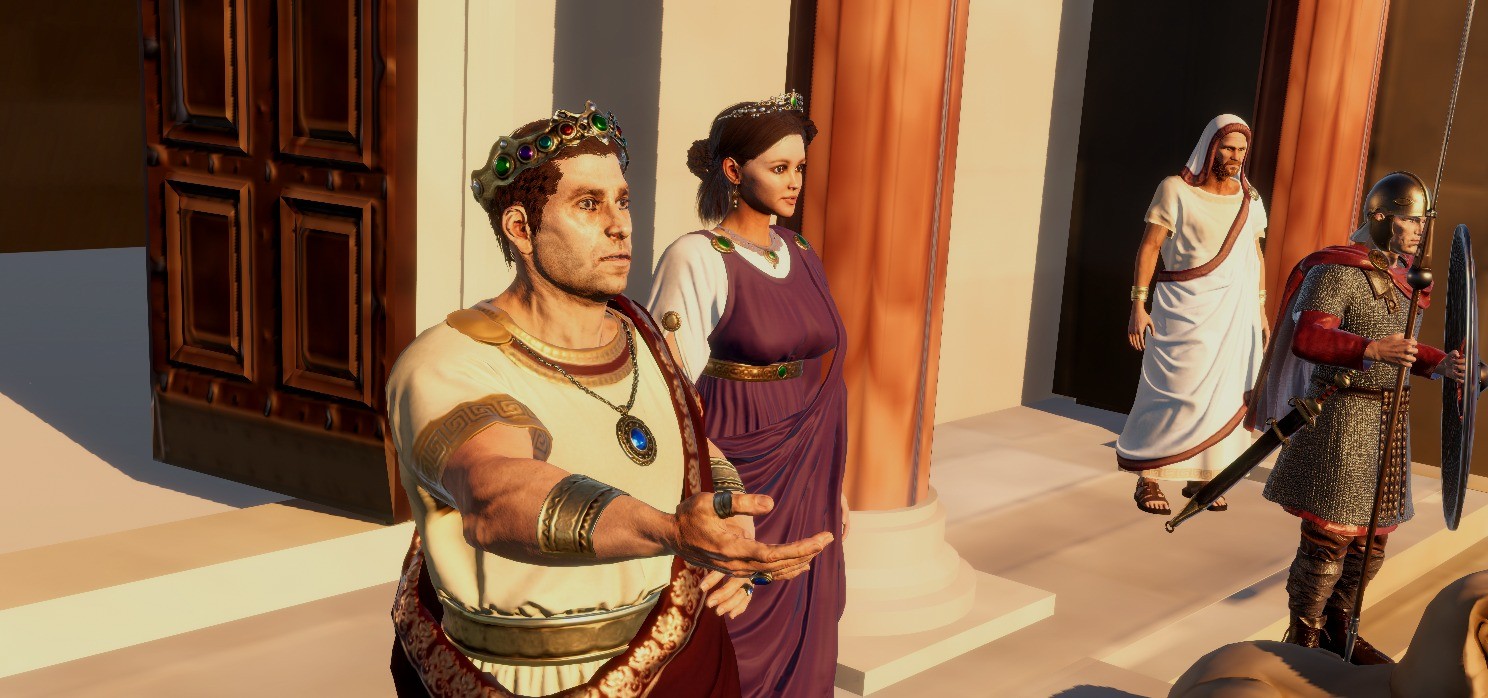
Using Meta Quest 3 headsets at two key locations — the Golden Gate and the Peristyle — we reconstruct the palace exactly as it stood in 305 AD: the painted statues, the gilded entrances, the Temple of Jupiter as a working temple, the Mausoleum as a Mausoleum, the courtyards alive with imperial guards and visitors. Your guide walks you through the rest of the palace on foot, explaining what you are seeing and how it changed.
80 minutes. €25. Rated ★ 5.0 across 170+ verified reviews.
It is, to our knowledge, the only way to see Diocletian's Palace as Diocletian saw it.
For broader visitor planning, our one-day Split itinerary places the VR tour at midday — after a self-guided walk through the palace at sunrise — and builds the rest of the day around the historical centre Diocletian created. For more ideas, see our roundup of things to do in Split, Croatia.
That depends on the framework. Politically and administratively, he was one of Rome's most effective emperors — restoring stability after fifty years of crisis and creating institutions that lasted for centuries. Morally, his persecution of Christians was a major and lasting black mark. Most modern historians regard him as transformative but flawed: a brilliant reformer with serious crimes attached to his record.
The cabbage anecdote is preserved in the late-4th-century Epitome de Caesaribus and is plausible but cannot be independently verified. Whether or not he literally gardened, the underlying claim — that he chose private retirement over a return to power — is well-attested. He is the first Roman emperor known to have voluntarily abdicated and stayed out of politics.
The reasons are debated. Diocletian was religiously conservative and viewed traditional Roman polytheism as essential to imperial unity. His Caesar Galerius is thought to have pushed for the more extreme measures. The persecution may also have been an attempt to reinforce a unified imperial cult at a moment when Christian numbers were growing rapidly. Whatever the immediate causes, the policy failed: Christianity survived and within a generation became the favoured religion of the empire.
In Split, Diocletian is regarded primarily as the founder of the city — without him, the modern city would not exist. The palace he built is the historic core of Split. The persecution and political legacy receive less local attention than his role as the city's effective creator. The Cathedral of Saint Domnius, ironically built inside his mausoleum, is one of Split's most important religious sites and is dedicated to a bishop Diocletian martyred.
The best surviving images of Diocletian are inside the Cathedral of Saint Domnius in Split — on the 3rd-century Roman frieze that runs around the dome drum. These portraits, carved during his lifetime, are the most reliable likenesses of the emperor anywhere in existence. There are also surviving coins, fragmentary statues in museums across Europe, and the famous porphyry sculpture of the Tetrarchs (showing Diocletian, Maximian, Galerius, and Constantius) currently set into the corner of the Basilica of San Marco in Venice.
Around 244 AD, near Salona — the Roman provincial capital of Dalmatia, located close to modern-day Solin in Croatia. His exact birthplace is unknown but was almost certainly somewhere within the territory of what is now Split-Dalmatia County.
Yes. The system of four emperors ruling jointly (two senior Augusti and two junior Caesars) was Diocletian's innovation, formalised in 293 AD. It was a radical departure from previous Roman practice and remains one of the most studied political reforms in late antique history.
After his abdication on 1 May 305 AD, Diocletian's Caesar Galerius became Augustus in the East, while Constantius Chlorus became Augustus in the West. New Caesars — Maximinus Daia in the East and Severus II in the West — were appointed beneath them. The succession was supposed to be orderly, but the Tetrarchy collapsed into civil war within eighteen months. The eventual winner, after nearly two decades of conflict, was Constantius's son Constantine the Great.
Approximately 66 to 68 years old. He was born around 244 AD and died between 311 and 313 AD — the exact dates of both events are uncertain.
The most reliable likenesses of Diocletian are preserved on the 3rd-century Roman frieze inside the Cathedral of Saint Domnius in Split — the building that was originally his own mausoleum. The portraits show a stern, broad-faced man with a short military beard, in keeping with the soldier-emperor style of the Tetrarchic period. Surviving coins and the famous porphyry Portrait of the Four Tetrarchs in Venice corroborate this impression.
Yes. Diocletian was married to Prisca, and they had one known daughter, Valeria. Valeria was married to Galerius — Diocletian's Caesar and eventual successor in the East — as part of the political binding of the Tetrarchy. Both Prisca and Valeria reportedly sympathised with Christianity. Both were executed around 314–315 AD by Licinius during the political turmoil following Diocletian's death. Diocletian had no known male heirs.
Diocletian was a native Latin speaker — like most Romans from the Balkan provinces — but he would have known Greek as well, since Greek was the language of administration and culture in the eastern half of the empire where he spent most of his reign. His birth name Diocles is Greek in origin, suggesting Greek cultural influence in his family or region.
Because he ended the Crisis of the Third Century — a fifty-year period when the empire nearly collapsed under invasions, civil wars, and economic breakdown. Through the Tetrarchy, military reform, monetary stabilisation, and administrative restructuring, Diocletian gave Rome roughly another two centuries of life in the West and over a thousand years in the East. Modern historians often regard him as the founder of the Late Roman or proto-Byzantine empire.
Three things, depending on who you ask. For political historians: creating the Tetrarchy and ending the Crisis of the Third Century. For religious historians: the Great Persecution of Christians (303–311 AD). For travellers and Croatians: building the palace at Split — one of the best-preserved Roman imperial residences in the world and the historical core of a city that has lived inside its walls for 1,700 years.
Yes — most notably the Baths of Diocletian in Rome, the largest public baths the empire ever built. Constructed between 298 and 306 AD and covering approximately 13 hectares, the baths could accommodate around 3,000 bathers simultaneously. In the 16th century, Michelangelo converted part of the complex into the Basilica of Santa Maria degli Angeli e dei Martiri on Rome's Piazza della Repubblica, where the original Roman vaulting can still be seen today. Diocletian also built or extensively rebuilt imperial palaces at Nicomedia (modern Izmit, Turkey) and Antioch, though far less of those structures survives.
The Dominate is the name historians give to the absolute monarchy that replaced the disguised monarchy of the early Roman Empire. Diocletian effectively founded it. Where earlier emperors maintained the fiction of being "First Citizens" (the Principate, dating from Augustus), Diocletian openly adopted the title Dominus et Deus — Lord and God — wore a jewelled diadem, demanded the ritual of proskynesis (kneeling and kissing the imperial robe), and surrounded himself with elaborate court ceremony inspired by the Persian and Hellenistic monarchies of the East. Every subsequent Roman and Byzantine emperor inherited this style from him.
Yes. In 296 or 302 AD — sources differ — Diocletian persecuted the Manichaeans, a religious sect of Persian origin whose followers he ordered burned alive or exiled to the mines. The Manichaean persecution prefigured the Christian one and reflected the same logic: Diocletian believed religious uniformity was essential to political unity, and viewed religions of foreign origin as threats to Roman order. The Manichaean and Christian persecutions are often discussed together by modern historians as part of Diocletian's broader programme of religious centralisation.
Once, in 303 AD, for the celebrations of his Vicennalia — the 20th anniversary of his reign. The visit was a major event: Diocletian and Maximian celebrated a joint triumph, inaugurated the still-incomplete Baths of Diocletian, and erected a Five-Column Monument in the Roman Forum. He apparently disliked the visit and left before the end of his consulship in January 304 AD, travelling north in poor weather and falling seriously ill. He never returned to the city.
Yes — and unlike most Roman imperial sites, you can do far more than visit. Diocletian's Palace is the living historic centre of Split. Around 3,000 people still live inside its 1,700-year-old walls. You can walk through the original Roman gates, stand in the ceremonial Peristyle, descend into the subterranean cellars, and enter the cathedral that was once Diocletian's mausoleum. The palace is open year-round, and entry to most of the complex is free. To see the palace as it stood in 305 AD — not as ruins, but as the working imperial residence Diocletian moved into — Time Walk's VR walking tour reconstructs the complex in full using Meta Quest 3 headsets at two key locations.
Primary ancient sources:
Modern scholarship:
Want to see Diocletian's palace as it looked when he lived in it? Book your Time Walk VR walking tour — an 80-minute guided experience through Diocletian's Palace in Split using Meta Quest 3 headsets, reconstructing the imperial complex as it stood in 305 AD.
Want to learn more about us? Read our story.
Or browse more from our blog:
.png)